SA-EgoGS: Sharpness-Aware Dynamic Gaussian Splatting for High-Fidelity Egocentric Interaction
Sharpness-aware dynamic 3D Gaussian Splatting for robust egocentric scene reconstruction with anti-aliasing and uncertainty-aware densification.
Overview
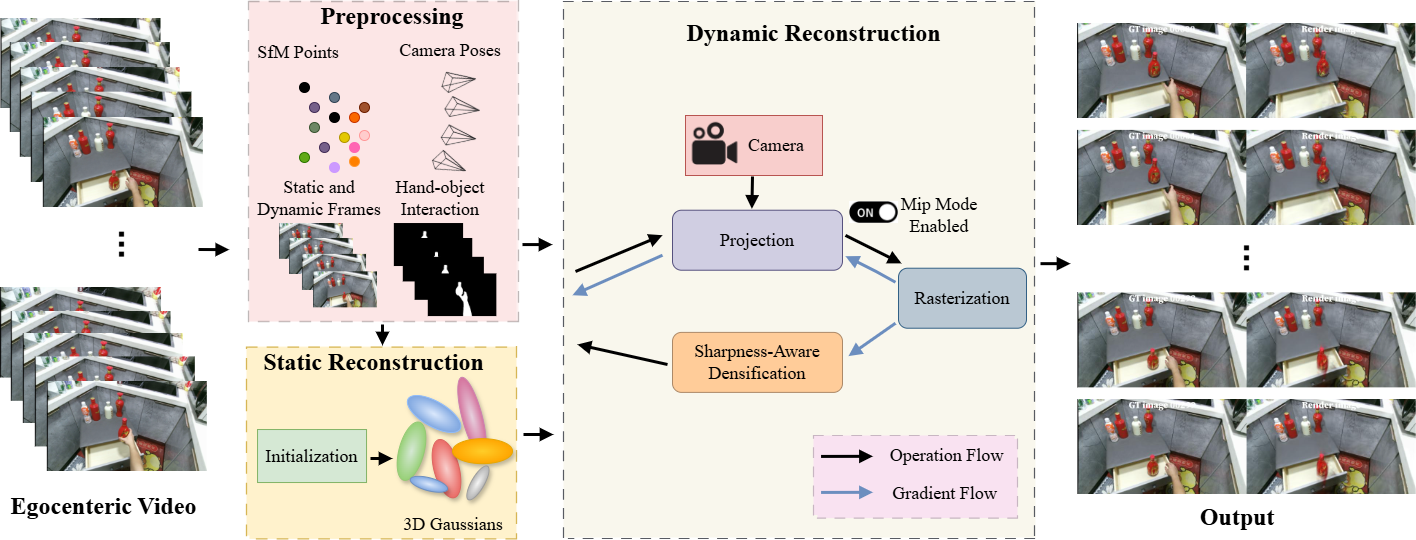
SA-EgoGS presents complementary mechanisms that improve the robustness of Gaussian-based dynamic reconstruction under egocentric capture conditions. The framework introduces sharpness-aware densification (SHAD) to prioritize high-frequency supervision in the presence of motion blur, scale-aware opacity capping (SAOC) to stabilize multi-scale alpha compositing, and Mip-style prefiltering (MSP) to reduce aliasing during dynamic rendering. Extensive experiments on HOI4D and EPIC-KITCHENS benchmarks demonstrate consistent improvements in spatial accuracy, perceptual quality, and temporal coherence over state-of-the-art methods.
Novel contributions
- 01
Sharpness-aware densification (SHAD)
Prioritizes high-frequency supervision signals during Gaussian densification, counteracting the blur bias inherent in motion-heavy egocentric video.
- 02
Scale-aware opacity capping (SAOC)
Stabilizes alpha compositing behavior across varying scales by dynamically capping Gaussian opacity based on projected footprint size.
- 03
Mip-style prefiltering (MSP)
Applies multi-scale prefiltering to Gaussian primitives during rendering, reducing aliasing artifacts in dynamic egocentric scenes.
Architecture
- 2026Under Review
SA-EgoGS: Sharpness-Aware Dynamic Gaussian Splatting for High-Fidelity Egocentric Interaction
Goshu, H.L., Wakjira, T.G., Lam, K.M. & Fouda, M.M.
Interested in this research?
For code access, collaboration or questions about SA-EgoGS, contact the AI4RISE Lab.